


U.S. Civil Rights Agency Moves to End Decades of Workplace Demographic Data Collection: Why Black America Should Pay Attention

By Brenton A McClanahan
BMB Empower Network
7/21/2026
“My people are destroyed for lack of knowledge.” — Hosea 4:6
“Knowledge is power. Data tells the story. And as Scripture reminds us, ‘My people are destroyed for lack of knowledge.’ We must stay informed, stay engaged, and never stop demanding accountability.”
For generations, Black Americans have understood a fundamental truth about the fight for equality: if discrimination is happening, you need evidence to prove it.
That is why a recent move by the U.S. Equal Employment Opportunity Commission deserves our attention.
The EEOC has moved toward eliminating the long-standing EEO-1 demographic reporting requirement, a system that has required many large employers to provide information about the race, ethnicity and sex of their workforce across different job categories.
This may sound like a bureaucratic change buried deep inside the federal government. But for Black Americans, the issue is much bigger than paperwork.
This is about data. This is about transparency. And ultimately, this is about accountability.
Why Does This Data Matter?
Think about the questions Black workers have been asking for decades.
Why are Black employees well represented at the bottom of an organization but almost invisible in the executive suite?
Why do qualified Black workers repeatedly get passed over for promotions?
Why do some companies celebrate diversity in advertisements while their senior leadership looks nothing like the communities they serve?
And when Black employees believe discrimination is occurring, how do we determine whether we are looking at an isolated incident—or a larger pattern?
Data helps us answer those questions.
Demographic workforce information can help researchers, civil-rights advocates and government enforcement agencies examine patterns in hiring and representation across different levels of employment.
Without comprehensive data, racial inequality doesn’t automatically disappear.
It can simply become harder to see.
Black Workers Still Face Unequal Outcomes

We cannot discuss workplace equality as if America has already solved racial discrimination.
Black Americans have made extraordinary progress in education, business, government and corporate America. Yet disparities remain in employment, income, wealth and representation in positions of power.
That is why collecting accurate information matters.
Imagine a company with thousands of employees. Black workers may represent a significant percentage of its workforce, but very few may reach senior management.
Without demographic information, how do we systematically measure that disparity?
How do we determine whether the situation is improving?
How do we hold institutions accountable when the numbers tell a troubling story?
You cannot seriously address a problem that you refuse to measure.
What This Does—and Does Not—Mean
We also need to be precise.
Ending the EEO-1 reporting requirement would not repeal the Civil Rights Act of 1964. Racial discrimination in employment would remain illegal. Black workers who experience unlawful discrimination would still have legal rights and avenues for filing complaints.
But there is an important difference between having a law on the books and having the tools necessary to effectively enforce that law.
Individual complaints can tell us what happened to one worker.
Data can help reveal what may be happening to thousands.
When you can examine employment patterns across companies and industries, you have a better opportunity to identify disparities that might otherwise remain hidden.
Removing a major source of standardized demographic information risks making that job more difficult.
This Is Bigger Than DEI

Some will frame this debate entirely around “DEI.”
Black America should understand that the underlying issue is much older than today’s political debate over diversity programs.
The EEO-1 reporting system dates back to the civil-rights era.
Our parents, grandparents and great-grandparents fought for a country where employers could no longer openly tell Black Americans, “We don’t hire your kind.”
The Civil Rights Act outlawed employment discrimination based on race and other protected characteristics. But passing a law did not instantly erase generations of discrimination.
Enforcement mattered.
Documentation mattered.
Evidence mattered.
And it still does.
The question before us today is whether America will continue collecting the information necessary to understand what is actually happening inside its workplaces.
Black America Must Stay Informed
We should never confuse the collection of demographic data with a guarantee of equality. Numbers alone cannot end discrimination.
But numbers can expose disparities.
Numbers can challenge narratives.
Numbers can force difficult conversations.
And numbers can provide evidence when institutions claim everything is equal while the reality tells a different story.
This is why Black Americans must pay attention to changes in civil-rights enforcement—even when those changes don’t immediately make the evening news.
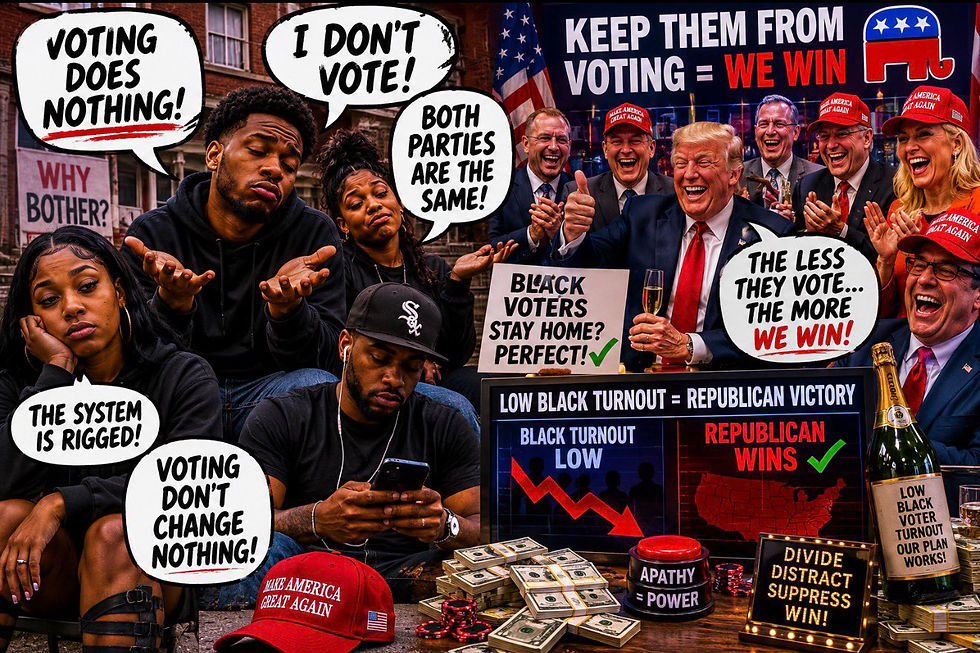
Our community cannot afford to focus only on presidential elections and congressional races. We must also understand what is happening inside the federal agencies responsible for enforcing the laws that affect our workplaces, businesses, schools, housing and voting rights.
Policy is power. Data is power. Information is power.
And when systems of accountability are weakened, the communities that have historically depended on civil-rights protections have every reason to ask tough questions.
For Black America, the message should be clear:
Stay informed. Know your rights.
Pay attention to policy.
Demand transparency.
Because discrimination does not disappear simply because America stops counting.
And we cannot fix inequality if we refuse to measure it.
— BMB Empower Network
Entertain, Educate, & Empower At The Same Time


Comments