


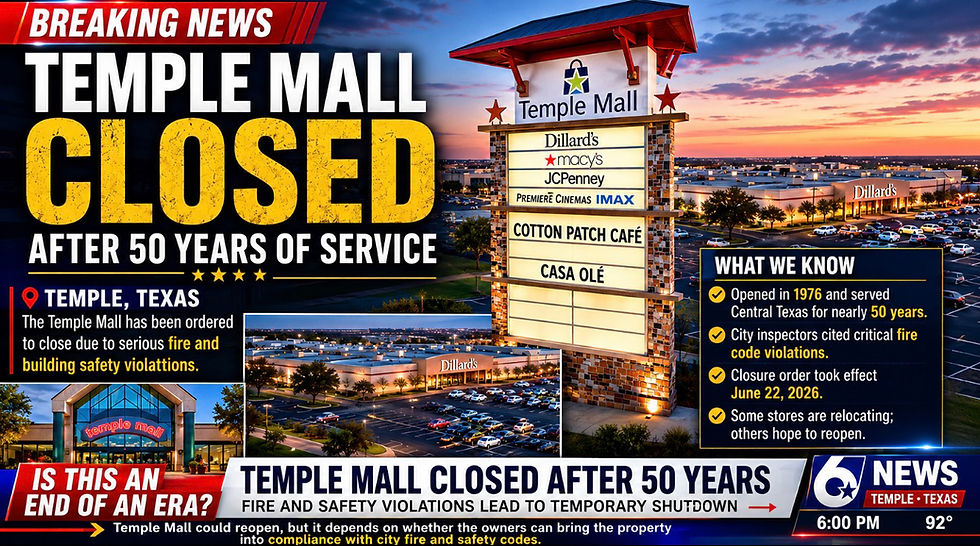
After nearly 50 years of serving Central Texas, Temple Mall has been forced to close following serious fire and safety violations.
By B.A. McClanahan
BMB Empower Network
June 23, 2026
🚨TEMPLE BREAKING NEWS🚨
After roughly 50 years in operation, the Temple Mall in Temple, Texas has been ordered to close due to serious fire and building safety violations. City officials issued notices requiring repairs to critical systems, including fire alarms, sprinklers, and fire pumps. When those issues were not fully resolved by the deadline, the city ordered a temporary closure beginning June 22, 2026.
What happened?
* Temple Mall opened in 1976 and served Central Texas shoppers for nearly five decades.
* The mall has struggled with declining occupancy and the loss of major anchor stores over the years.
* A proposed $50 million redevelopment plan was recently canceled.
* Fire inspectors cited major life-safety concerns, leading to the closure order.
* Some businesses are relocating while others hope to reopen if the property can be brought into compliance.
For many Texans, Temple Mall wasn’t just a place to shop—it was a place where memories were made.
BUT
Temple Mall could reopen, but it depends on whether the owners can bring the property into compliance with city fire and safety codes.
The closure was not because the city permanently condemned or demolished the mall. The city ordered it closed because inspectors found serious issues involving fire protection and life-safety systems. If the owners repair those systems, pass inspections, and receive approval from city officials, the mall could potentially reopen.
However, there are some challenges:
* Cost of repairs: Fire alarm, sprinkler, and other safety system upgrades can be expensive.
* Tenant losses: Some businesses may permanently relocate rather than wait for the mall to reopen.
* Redevelopment uncertainty: A proposed redevelopment project was previously canceled, raising questions about the property’s long-term future.
* Retail trends: Many traditional malls across America have struggled with declining foot traffic and store closures.
Possible Outcomes
1. Reopen as a mall after repairs are completed.
2. Partial reopening with only certain sections or businesses operating.
3. Redevelopment into a mixed-use property with retail, offices, apartments, entertainment, or community space.
4. Permanent closure and redevelopment if repairs are deemed too costly.
For many Temple residents, there’s hope the property can be saved because it remains one of the city’s most recognizable landmarks and has served Central Texas for nearly 50 years.
For a regional mall the size of Temple Mall, repairs could fall into three broad ranges:
Scenario
Estimated Cost
Minor repairs and code updates
$500,000–$2 million
Major fire alarm, sprinkler, and life-safety upgrades
$2 million–$10 million
Full modernization plus deferred maintenance
$10 million–$30+ million
Factors that affect the cost include:
* Replacing or repairing the fire alarm system
* Upgrading sprinkler systems and fire pumps
* Electrical and HVAC repairs
* Roof and structural maintenance
* Bringing older areas up to current building codes
* Occupancy permits and inspection requirements
The bigger question may not be whether the repairs can be made, but whether the investment makes financial sense. If the mall’s occupancy is low and redevelopment plans are being considered, owners may decide that converting the property into a mixed-use development, entertainment district, medical offices, apartments, or a community center is a better investment than reopening it as a traditional mall.
For comparison, recent mall redevelopments around Texas and the U.S. have often cost $50 million to several hundred million dollars, while code-compliance repairs alone are usually much less expensive.
Bottom line: If the problems are primarily fire-code related, Temple Mall could potentially reopen with repairs in the low millions of dollars. If extensive modernization is needed, costs could climb into the tens of millions.
Now my opinion:
Temple Mall’s situation is part of a much larger trend affecting malls across the United States.
Why are malls struggling?
1. Online shopping
* Amazon and other e-commerce retailers have reduced foot traffic at traditional malls.
* Many shoppers now buy clothing, electronics, and household goods online.
2. Department store closures
* Anchor stores such as Macy’s, JCPenney, and Sears have closed hundreds of locations nationwide.
* When anchors leave, smaller stores often lose customers.
3. Aging infrastructure
* Many malls built in the 1970s and 1980s require expensive repairs to roofs, HVAC systems, fire suppression systems, and electrical infrastructure.
* Some owners defer maintenance because revenue has declined.
Now my emotional good memories:
If you grew up in Temple in the 90s, Temple Mall wasn’t just a mall—it was our gathering place.
Back then, there weren’t a lot of places for kids and teenagers to hang out. Temple Mall was where life happened.
I can still hear my mom saying she needed to “run into Dillard’s real quick.” We all knew that meant we’d be there for a while. Dillard’s was her favorite store because she knew exactly where everything was. The moment she disappeared into the department store,
I’d start negotiating:
“Mama, can I go to Tilt Arcade?”
And off I’d go.
I’d walk through the mall dreaming over the newest toys at KB Toys, checking out the latest CDs at the music store. Nothing beat the sound of the games, the flashing lights, and the excitement of seeing how long your quarters could last.
Christmas at Temple Mall felt magical. The decorations stretched throughout the mall. Christmas music filled the air. The Santa setup near JCPenney seemed larger than life. As a kid, it felt like stepping into a holiday movie.
And who could forget the anchor stores? Dillard’s, JCPenney, Sears, and Foley’s—not Macy’s. Macy’s came much later. Those stores were landmarks. Everybody knew exactly where to meet because everyone knew the mall.
As the years went on, things changed. Sears eventually closed, and Stein Mart moved in. We shopped at Foot Action, Foot Locker, The Shoe Department, Kay Jewelers, and grabbed drinks from Lexxi’s Ice Coffee Shop. Service Merchandise was another Temple favorite that many of us still remember.
Then there was the food. Orange Julius. Fuddruckers. Niki’s Roma Pizza. Temple’s original Chick-fil-A. The smells alone could make you hungry before you even reached the food court.
And does anybody remember the Ferris wheel that sat in front of Dillard’s? For kids, it was one of the coolest things about the entire mall.
Temple Mall wasn’t just a place to shop. It was where families spent weekends, where friends met up, where holiday memories were made, and where generations of Temple residents shared experiences together.
Today, as we watch the mall’s story come to an end, it’s hard not to feel a little emotional. Could it come back someday? Maybe. Stranger things have happened.
But whether it reopens or not, the memories will always remain.
For many of us, Temple Mall wasn’t just a building.
It was part of growing up.


Comments